
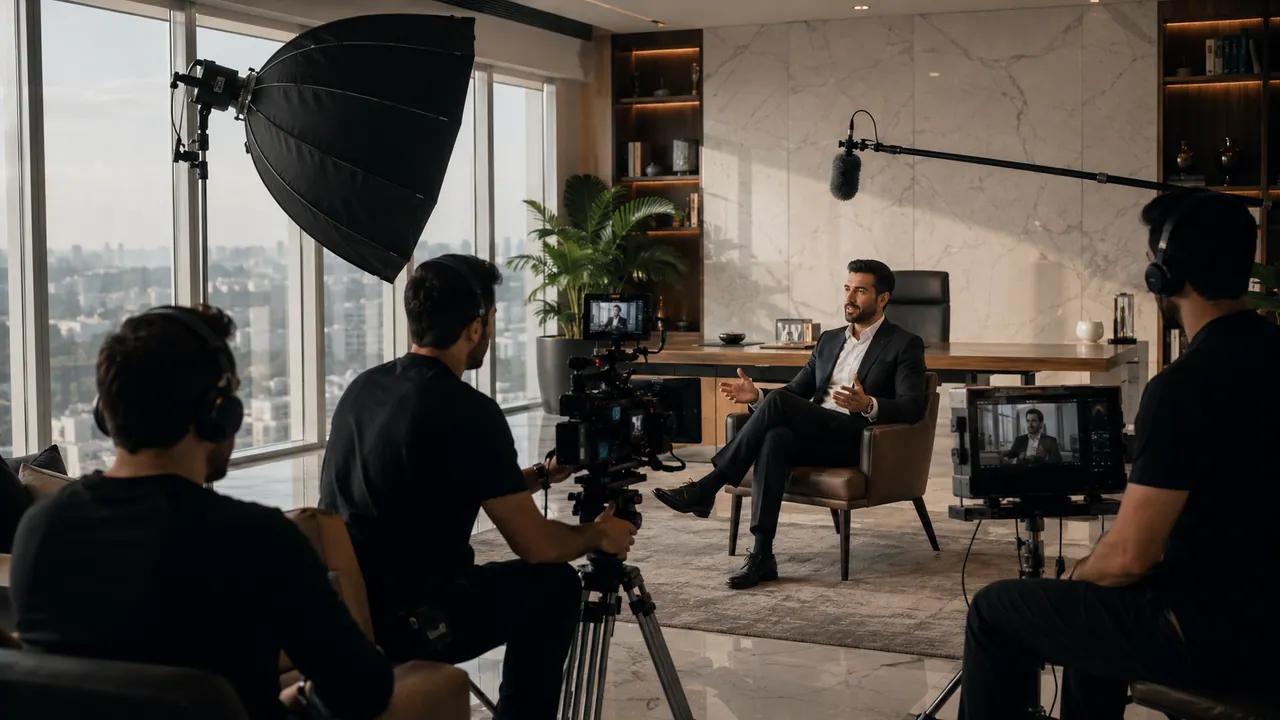
Corporate video production in Pakistan is the full process of planning, filming, and editing video for a business: company profiles, brand films, customer testimonials, product and training videos, and event coverage. A professional production runs through five stages: discovery, pre-production, filming, post-production, and delivery. This guide covers the formats worth investing in, how each stage actually works, what to prepare before you brief a studio, and how to choose a production partner in Lahore, Islamabad, or Karachi.
What corporate video production actually means
"Corporate video" is a category, not a single product. It covers any film a business makes to explain itself, sell something, train someone, or prove a claim. What separates professional corporate film production from someone with a good camera is everything that happens around the shoot: a brief interrogated properly, a script written to a purpose, a crew directed on the day, and a post-production process that grades, mixes, and finishes the film for every place it will be seen.
That distinction matters more than most brands expect. The equipment gap between a hobbyist and a studio has closed. Cameras are cheap and everywhere. The gap that has not closed is judgement: knowing which story to tell, which shot earns its place, and which version of the film your audience will actually finish watching.
The corporate video formats Pakistani brands invest in most
Decide the format before you talk budget. Format, not length, determines how a film is made:
- Company profile film, the flagship. Who you are, what you do, and who you do it for. Used on the website, in tenders, at trade shows, and in investor and partner meetings.
- Brand film, story-led rather than fact-led. Sells a belief or a positioning rather than a service list, and ages far more slowly than a profile.
- Customer testimonial films, with real clients on camera describing a real outcome. The single most persuasive asset most B2B brands can own.
- Product and explainer videos, showing how something works, for launches, sales teams, and support pages.
- Corporate social ads, short, sound-off-first cuts built for LinkedIn, Instagram, and YouTube placement rather than a boardroom screen.
- Event and conference films, with a same-week highlight cut plus session recordings and speaker soundbites.
- Training and internal comms, covering onboarding, safety, SOP, and leadership communication films.
- CSR and impact documentaries, longer-form storytelling for foundations, development-sector work, and sustainability reporting.
One shoot can serve several of these at once if it is planned that way from the start. A single well-scoped production day can yield a profile film, three testimonial cutdowns, and a set of social video ads, but only if the extra deliverables are in the brief before the crew arrives, not requested after the wrap.
Stage 1: Discovery, the brief behind the brief
Every serious production starts with questions, not a quote. Who is this film for? What do they currently believe, and what should they believe after watching? Where will they see it, and on what device? What does success look like: enquiries, applications, shortlisting in a tender, alignment inside the company? If a studio skips all this and jumps straight to a price, it is quoting you a shoot rather than a result.
Stage 2: Pre-production, where the money is saved
Pre-production is the least visible and most valuable stage. It covers the concept and treatment, the script, the shot list, casting or speaker selection, location scouting and permissions, the shoot schedule, and the call sheet. Decisions made here cost nothing; the same decisions made on the shoot day cost a crew's hourly rate, and made in the edit they can cost a reshoot.
- Treatment: the visual and tonal plan, how the film looks, moves, and sounds.
- Script or interview guide: every line for scripted work; a question structure for interview-led films.
- Shot list and schedule: what is captured, in what order, and how long each setup realistically takes.
- Locations and permissions: access, power, noise, lighting conditions, and permits where a site or airspace requires them.
- Approvals: who signs off, and when. Ambiguity here is the most common cause of delay in corporate projects.
Stage 3: Production, the shoot day
On the day, a directed crew runs to a schedule: lighting and camera setups, sound, direction of on-camera speakers, and b-roll of the workplace, product, or process. For films where scale is part of the story, such as a plant, a campus, a hotel, or a development, drone and aerial cinematography adds establishing shots that ground-level cameras simply cannot reach, provided the operator is licensed and the airspace is cleared in advance.
The most common client-side mistake on a shoot day is underestimating access. Crews lose hours to locked floors, unbriefed security, meeting rooms still in use, and executives arriving late for a two-minute piece to camera. A named on-site coordinator with the authority to open doors is worth more to your budget than any piece of equipment.
Stage 4: Post-production, where the film is actually made
Editing, colour grade, sound mix, music, graphics, subtitles, and versioning all happen in post-production. This stage usually takes longer than the shoot itself, and it is where a good film separates from a competent one. Sound in particular is chronically under-budgeted: viewers forgive imperfect footage and abandon bad audio within seconds.
Stage 5: Delivery, cut for where it will live
A film for a boardroom, a LinkedIn feed, and a trade-show loop are three different edits. Agree the deliverable list up front (master cut, social cutdowns, aspect ratios, burned-in captions for sound-off viewing, subtitle files, and compressed web versions) so one production yields a family of assets instead of a single video you later have to pay to re-cut.
What to prepare before you brief a production house
The brands that get the best work, and the fastest, most accurate quotes, arrive with these ready:
- The objective in one sentence, expressed as a business outcome rather than a video description.
- The audience, and where they will watch: website, LinkedIn, a pitch meeting, a screen at an exhibition stand.
- Two or three reference films you admire, with a note on what specifically you like about each.
- Brand assets: logo files, fonts, colour palette, tone-of-voice guidance, and any existing footage worth reusing.
- Locations and availability: sites you can access, and the dates key people are genuinely free to be on camera.
- The decision chain: who approves the script, the cut, and the final film.
- A budget range. Withholding it does not get you a better price; it gets you a proposal scoped for the wrong project.
How to choose a corporate video production company in Pakistan
Portfolios are marketing. Look past the showreel and check for the things that predict how a project will actually go:
- Relevant work, not just beautiful work. Has the studio handled your kind of subject, whether that is a factory floor, a hospital, a hotel, or a boardroom?
- A real process. Can they describe pre-production, approvals, and revision rounds without being asked?
- An itemised quote. Scope written down beats a single lump-sum figure every time.
- Named crew: who directs, who shoots, who edits. Studios that subcontract everything are hard to hold to a standard.
- Licensing discipline: music, stock, and talent usage rights cleared properly, which matters the moment a film runs as paid media.
- Post-production capability in-house. It is the stage most likely to be rushed when it is outsourced.
- Communication under pressure. How they responded to your first email is a fair preview of how they will handle a shoot-day problem.
The most reliable test is to watch a full film end to end rather than a showreel of best moments. A reel proves a studio can capture a beautiful shot; a finished film proves it can hold a story together for three minutes. Our portfolio is published in full for exactly that reason.
Filming across Pakistan: Lahore, Islamabad, Karachi and beyond
Most national brands have sites in more than one city, and the practical question is whether to hire a local crew per city or travel one team. Travelling a single crew keeps the look, sound, and direction consistent across every location (the same lighting approach, the same interview framing, the same grade) at the cost of travel and accommodation. Hiring separately in each city saves travel but often produces footage that will not cut together cleanly.
Paper Boat is based in Lahore and travels nationwide, including Islamabad, Karachi, Multan, Faisalabad, and Peshawar. Where multiple sites are involved, the efficient plan is usually one production block covering all locations back to back, rather than separate shoots months apart.
How long does a corporate video take?
Timelines depend on scope, but the shape of a schedule is predictable: discovery and scripting first, then a locked shoot date, then post-production, which almost always takes longer than the filming itself. Interview-led films with a single location move fastest. Scripted films with talent, multiple locations, motion graphics, or several rounds of stakeholder approval take considerably longer, and approval rounds are usually the real variable rather than the production work.
If you have a fixed launch date, such as a conference, a product release, or a financial-year close, work backwards from it and share that date in your very first message. It changes how the whole project is planned.
Mistakes that waste a corporate video budget
- Trying to say ten things in one film. Every extra message reduces the impact of the others. Five messages is five focused videos.
- Approving a script by committee without a single decision-maker, then rewriting it during the edit.
- Booking a shoot before deciding where the film will be published, then discovering you need a vertical cut you did not shoot for.
- Spending the whole budget on the shoot day and leaving nothing for sound, grade, and captions.
- Making one film a year instead of planning a shoot that produces a quarter's worth of content.
- Treating the film as finished at delivery, with no plan or budget for actually distributing it.
For the craft side of this (hooks, pacing, and holding attention), read our companion piece on creating engaging corporate videos, and on capturing client stories that convert, the power of testimonials.
Start with the destination, not the camera
A corporate video is worth making when it has a job to do and a place to live. If you know what that job is, tell us where you want to arrive (the audience, the outcome, and the deadline) and we will shape the production around it. If you want to understand what it will cost first, read our breakdown of corporate video production costs in Pakistan.
Frequently asked questions
- What is corporate video production?
- Corporate video production is the process of planning, filming, and editing video for a business, including company profile films, brand films, customer testimonials, product and training videos, and event coverage. A full production runs through discovery, pre-production, filming, post-production, and delivery.
- How much does corporate video production cost in Pakistan?
- There is no fixed rate card. Cost is built from scope: the number of shoot days, crew size, whether the film is scripted or interview-led, the demands of post-production, and travel. Paper Boat quotes each project individually; share your brief and we will cost it against your objective.
- Which cities in Pakistan do you film in?
- Paper Boat is based in Lahore and travels nationwide, including Islamabad, Karachi, Multan, Faisalabad, and Peshawar. Additional travel costs may apply for shoots outside Lahore.
- Do you produce wedding videos?
- No. Paper Boat specialises in corporate, commercial, and event photography and videography. We do not take wedding work.
- How long does a corporate video take to produce?
- It depends on scope. Interview-led films at a single location move fastest; scripted films with talent, multiple cities, or motion graphics take longer. Post-production usually takes longer than the shoot itself, and stakeholder approval rounds are often the biggest variable. If you have a fixed launch date, share it in your first message so the schedule can be built backwards from it.
- What should I prepare before briefing a production house?
- Your objective in one sentence, the audience and where they will watch, two or three reference films, brand assets, accessible locations and dates, the approval chain, and a budget range. Arriving with these produces faster, more accurate proposals.