
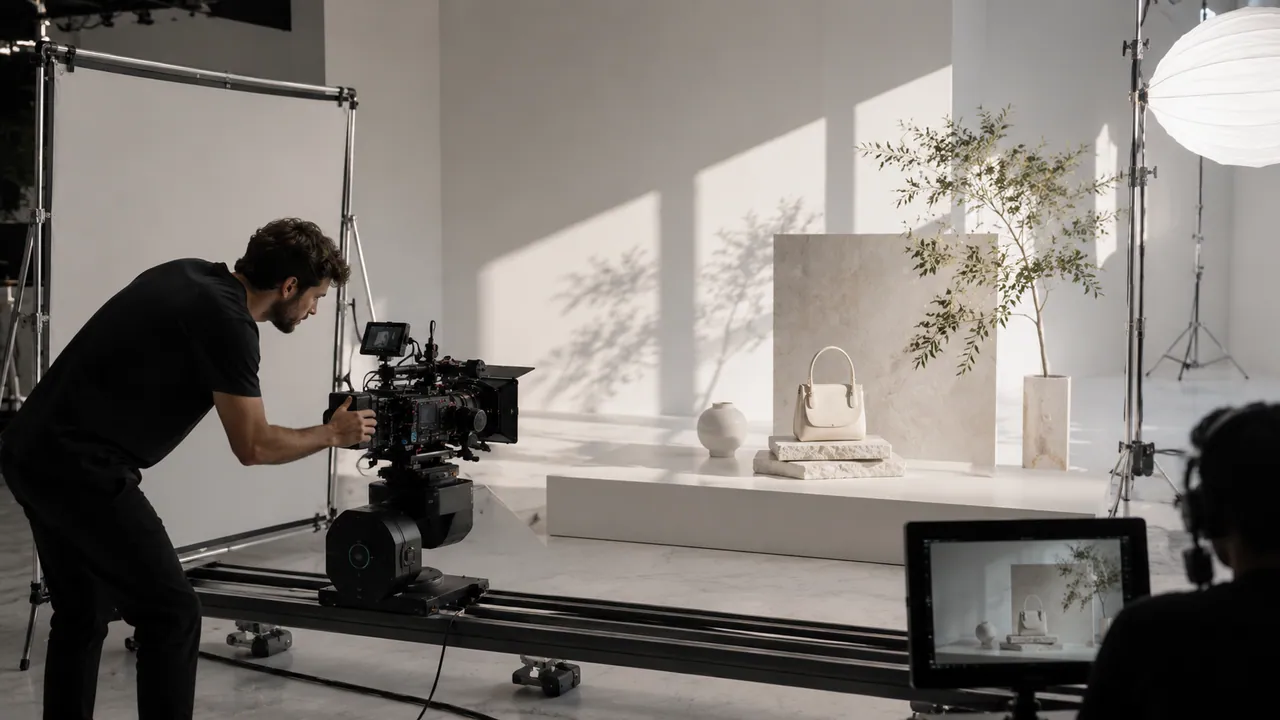
There is no single price for a corporate video in Pakistan, because corporate video is not one product. The cost is assembled from scope: how many shoot days, how large a crew, whether the film is scripted or interview-led, how demanding the post-production is, how many cities are involved, and what rights you need. Two studios quoting the same brief can differ several times over and both be honest, because they are quoting different productions. This guide breaks down every line item so you can budget realistically and compare quotes fairly.
Why production houses quote per project instead of publishing prices
A published rate card would only work if every corporate video were the same shape. In practice, a one-day interview film with two speakers and a two-day scripted brand film with talent, a lighting package, aerial coverage, and motion graphics share almost nothing except the word "video." A studio that publishes one flat figure is either quoting the cheapest possible version of the job, or quoting high enough to cover the worst case, and you pay for that padding.
The useful question is therefore not "what is your rate?" but "what does this specific film require, and what does each part of it cost?" That is a question any serious studio can answer in an itemised proposal within a few days of a proper brief.
The eight factors that actually move the price
- Shoot days: the single biggest lever. Every additional day multiplies crew, equipment, travel, and catering simultaneously. Compressing three locations into one well-planned day is the most effective saving available to most clients.
- Crew size: a two-person team covering an interview is a different budget from a director, DOP, gaffer, sound recordist, assistant, and producer on a directed set.
- Scripted versus interview-led: scripted work requires writing, storyboarding, casting, direction, and often talent fees. Interview-led films replace all of that with a question guide and a good interviewer.
- Equipment package: camera body and lenses are the smaller part; lighting, grip, gimbals, jibs, and dedicated sound gear are what scale a package up.
- Locations, permits and travel: filming inside your own office is cheap. A hired location, a plant with safety requirements, restricted airspace, or a crew flown to another city are all separate lines.
- Talent: professional actors, models, presenters, or voice artists carry both a day rate and usage rights, which are priced by where and how long the film runs.
- Post-production complexity: a clean interview edit is far cheaper than a film requiring motion graphics, 3D, heavy VFX, colour-critical grading, an original score, or multi-language subtitling.
- Deliverables and versions: one master cut costs less than one master plus six social cutdowns in three aspect ratios with burned-in captions. Version count is a real cost, and it is the one most often left out of a brief.
What a proper quote should itemise
Ask for the scope in writing. A quote you can actually evaluate breaks down into these lines:
- Pre-production: concept, script or interview guide, treatment, shot list, scheduling, and location recce.
- Crew: named roles and the number of days each is booked.
- Equipment: camera, lighting, grip, sound, and any specialist kit such as drone or gimbal.
- Locations and permits: hire fees, access, power, and permissions.
- Talent: day rates plus usage rights and duration.
- Travel and logistics: transport, accommodation, and per-diems for out-of-city shoots.
- Post-production: editing, colour grade, sound mix, graphics, and subtitles, stated as days or as a fixed stage fee.
- Music and stock licensing: the licence type and the territory or platform it covers.
- Revisions: how many rounds are included, and what an extra round costs.
- Deliverables: every file you will receive, including durations, aspect ratios, caption versions, and formats.
- Payment terms and cancellation: deposit, milestones, and what happens if a shoot date moves.
If a quote is a single number with no breakdown, you cannot tell whether the sound mix, the second cutdown, or the third revision round is inside it, and those omissions are where budget overruns come from later.
Three levels of corporate video, and what changes between them
Most corporate work falls into one of three shapes. Identifying yours before you ask for quotes is the fastest way to a realistic budget.
Level 1: Interview-led
One location · one day
- Small crew, natural or light-supplemented setups
- Two to four speakers plus workplace b-roll
- Clean edit with music and captions
- Best for testimonials, culture films, and straightforward profiles
Level 2: Directed brand film
One to three days
- Script or narrative structure, larger crew
- Full lighting and grip package, controlled locations
- Grade, sound design, and motion graphics in post
- The standard for a flagship film that must hold up for years
Level 3: Full commercial
Multi-day · talent · high-end finish
- Casting and talent with usage rights
- Art direction, set dressing, specialist equipment
- Aerial coverage and original music
- For films running as paid media, where production value is the message
The jump between levels is not cosmetic. It changes the crew, the schedule, and the amount of craft in the finish, which is why the same three-minute runtime can sit anywhere across a wide range. Our services page sets out which capabilities each kind of production draws on.
The costs brands most often forget to budget
- Music licensing: a track that is fine for an internal screening may not be licensed for a paid campaign. The licence, not the track, is the cost.
- Talent usage rights: a model or presenter fee usually covers a defined period and set of platforms. Extending either is a new negotiation.
- Subtitles and translation: Urdu and English versions, plus burned-in captions for sound-off social viewing.
- Versioning: a 16:9 master, a 1:1 feed cut, a 9:16 vertical, and a 15-second teaser are four edits, not one.
- Extra revision rounds: usually reasonable to add, but only if you know the per-round cost before you start.
- Overtime and date changes: a shoot day that runs long or moves at short notice has a real cost attached to crew and hire.
- Archive and reuse: keeping raw footage available for future edits is often cheaper than reshooting, and worth asking about explicitly.
How to get an accurate quote quickly
Studios quote fast and accurately when the brief answers these. Send them in your first email and you will usually have a costed proposal in days rather than weeks:
- The objective, stated as a business outcome rather than a video description.
- Where the film will run: website, LinkedIn, paid media, an event screen, a sales meeting.
- Approximate runtime and the number of cutdowns you need.
- Locations and cities involved, and whether you control access to them.
- Whether you need talent, or whether real staff and customers will appear.
- Two or three reference films, with a note on what you like about each.
- Your deadline and any fixed launch date.
- A budget range. A range, not a number. It scopes the proposal to something you can actually approve.
Getting more value from the same budget
- Shoot once, deliver many. Plan the cutdowns before the shoot so one production day feeds a quarter of content instead of a single film.
- Consolidate locations. Two sites in one day beats one site on two days almost every time.
- Choose interview-led over scripted where the story allows. Real voices are cheaper to capture and frequently more persuasive.
- Protect the finish. Cutting the sound mix, grade, or captions to save a small amount is the fastest way to make an expensive shoot look cheap.
- Lock the script before the shoot. Rewrites during the edit are the most expensive way to change your mind.
- Name one approver. Committee revisions cost more than any equipment line on the quote.
Cheap versus expensive: what you actually give up
The lowest quote is rarely the lowest cost. What gets removed to reach it is usually pre-production, sound, grading, and revision allowance, the four things that decide whether a film reads as considered or improvised. A film that cost less but never gets used, or that has to be remade a year early because it looks dated, was not cheaper.
Equally, an expensive quote is not automatically better. Ask what the extra buys: more shoot days, a bigger lighting package, talent rights, longer in the edit? If a studio can't explain what a line item does for your film, it probably isn't doing anything for it.
Get a costed proposal for your project
Paper Boat prices every project against its scope rather than a rate card, because the honest answer to "how much does a corporate video cost" depends entirely on what the film has to do. Send us the objective, the audience, the locations, and the deadline, and we will come back with an itemised proposal. Start the conversation, or read the full guide to corporate video production in Pakistan to understand what each stage involves before you brief anyone.
Frequently asked questions
- How much does a corporate video cost in Pakistan?
- Pricing varies based on the scope of the project. Cost is built from shoot days, crew size, whether the film is scripted or interview-led, the complexity of post-production, travel, talent, and the number of deliverables, not from a fixed rate card. Contact Paper Boat with your brief for a customised quote.
- Does a longer video always cost more?
- Not necessarily. Runtime matters far less than production complexity. A 60-second scripted commercial with talent, a full crew, and motion graphics costs considerably more than a five-minute interview-led company profile filmed in one day at one location.
- Do corporate video rates differ between Lahore, Islamabad and Karachi?
- The production work itself is priced the same way in each city. What changes is logistics: travel, accommodation, and per-diems for an out-of-city crew, plus any location or permit costs specific to the site. Consolidating multiple cities into one production block is usually cheaper than separate shoots.
- What should be included in a corporate video quote?
- A quote you can evaluate itemises pre-production, crew and days, equipment, locations and permits, talent and usage rights, travel, post-production, music and stock licensing, the number of included revision rounds, and every deliverable with its duration and aspect ratio, along with payment terms.
- What is the most cost-effective type of corporate video?
- An interview-led film shot at a single location in one day. It removes scripting, casting, and talent fees, and a well-planned day of it can produce a company profile plus several testimonial and social cutdowns from the same footage.
- Are music and footage licensing included in the price?
- Always confirm this in writing. Music, stock footage, and talent usage rights are licensed for specific platforms and time periods, and a licence that covers an internal screening may not cover a paid advertising campaign. It should appear as its own line in the quote.